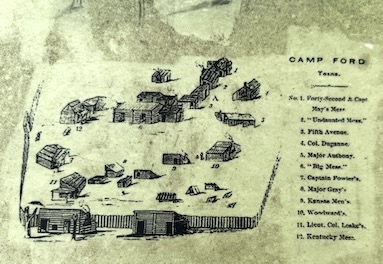
Did you know that there was a Civil War P.O.W. camp in Texas? Did you know that it was the largest one “west of the Mississippi River,” at one point holding over 5000 Union prisoners?

Once again, we were thrilled to stumble onto something fascinating just driving to our destination. Camp Ford Historic Park is located in Smith County, just outside of Tyler, Texas, at the corner of Hwy 271 and Loop 323. It is now a public park owned by the county.
The Camp Ford site is small, one of those “don’t blink or you’ll miss it” kind of things. As a matter of fact, we both saw the sign, and it took a couple of seconds to register so then we turned around to go back.

Pulling into the parking lot, there are log structures, reminiscent of how a fort or stockade looks. Informational signs placed on the log walls tell the history of the camp.

Step out onto the short walking trail to read more informational signs, and to see remains of logs and rocks that were probably from chimneys.

The path does say it’s ADA-accessible, but it is a little bit rough in spots. There is also a sign warning where the ADA section ends and it’s just dirt that could be harder to navigate.
The signs tell the story of how the camp was established in August of 1863 and finally closed on May 19, 1865. P.O.W.s were from every Union state except Delaware and Vermont. In the winter of 1863 to 1864 it only had 170 prisoners, with life considered comparatively pleasant with crafts and other activities to keep the men busy. A few log cabins were built as well.

Then in March of 1864, 700 prisoners in Shreveport, Louisiana were taken to the camp. By that summer the population exploded to around 5000 men. That made supplies and shelter extremely inadequate, and most men just had to dig holes for shelter or use whatever tree branches, blankets, or anything else they could use to make a shelter. Later that year new tools were sent to the fort so they were able to build better housing.

Over the period the camp was in use there were 316 deaths, which is low for a P.O.W. camp. It is believed this is because of good clear water in the spring by the camp, and because of a system that was developed to catch water and separate it into drinking water, washing water, and bathing water.

Camp Ford also has the distinction of being known for holding the most naval prisoners of any Civil War P.O.W. camp.

An interesting personal connection for me was the plaque showing the different Union Regiments imprisoned there, which includes 41 men from the 33rd Iowa Infantry. My great-great-great grandfather, James Hazerel Wycoff, and his brother, John Wesley Wycoff, were in that unit. However, they were both already deceased by the time this camp was established – James was killed at a battle in Helena, Arkansas on July 4, 1963, at just 20 years old. His one and only child, a son, was born just 21 days later. John died the following month of pneumonia or typhus. But I wonder – how many of those 41 men at Camp Ford had served with my ancestors?
The address for Camp Ford is 6500 US Highway 271, Tyler, Texas. Admission is free.



Leave a comment